
You're probably sitting with twelve browser tabs open, a Pinterest board that swings from airy garden romance to bright modern color, and one stubborn question in your head: can you really do your own wedding flowers without turning the final week into a complete mess?
Yes, you can. But diy wedding flowers go wrong for very predictable reasons. Couples order pretty blooms before they've chosen a usable style. They underestimate how much labor sits between boxed stems and polished arrangements. They forget that flowers are living things with a narrow window for hydration, storage, and handling. The heartbreak usually isn't design. It's logistics.
That's the part I'd walk you through first if you were family. Flowers reward good timing more than grand ambition. If you build a style you can repeat, buy with restraint, hydrate correctly, and assign jobs clearly, you can have flowers that feel personal and look cared for instead of rushed.
Table of Contents
- Defining Your Floral Vision and Style
- Budgeting and Sourcing Your Wedding Flowers
- Gathering Tools and Prepping Your Blooms
- Assembling Your Arrangements Like a Pro
- Your Wedding Week Flower Timeline
- Troubleshooting, Transport, and Preservation
Defining Your Floral Vision and Style
The strongest diy wedding flowers start with restraint. Not more inspiration. Restraint.
If your board includes meadowy wildflowers, sculptural orchids, tight formal roses, dried elements, and tropical foliage all at once, you don't have a floral vision yet. You have saved images. A usable vision gives every choice a filter: what belongs, what doesn't, and what can be swapped if a flower isn't available in the form or color you wanted.
Build a mood board that narrows your choices
Start with three words. Not ten. Something like romantic, garden, loose or modern, graphic, bold. Those words should describe shape as much as color.
Then sort your inspiration by these design signals:
- Bloom shape: Round blooms feel classic and full. Spiky or branching stems feel airy and a little wilder.
- Texture level: Smooth petals read cleaner and more formal. Frilly, ruffled, or feathery ingredients make things feel softer and more layered.
- Movement: Upright line flowers add lift. Heavy focal blooms create weight. Trailing greenery adds drape, but too much can make beginner work look tired instead of elegant.
- Palette temperature: Warm palettes feel generous and lively. Cool palettes feel quieter and more restrained.
Practical rule: If an inspiration image only works because of a flower you can't reasonably source or handle, it isn't your reference image. It's just pretty research.
Sketching helps more than most couples expect. A rough bouquet circle, a table centerpiece silhouette, and a ceremony arrangement outline will tell you very quickly whether your ideas repeat well or only look good in a single photograph. If you like the gathered, natural look, browsing examples of rustic flower arrangements can help you separate “casual” from “messy,” which are not the same thing.
Choose a palette that still looks good in real flowers
Color trends have moved in a clear direction. Searches for “vibrant wedding flowers” increased by 300% in 2025, “pink and orange flowers” increased by 200%, and “colorful bridal bouquet” increased by 267%, according to the 2025 wedding flower trend roundup. That lines up with what many growers and designers have seen in real weddings: fewer whispery palettes, more personality.
That doesn't mean you need electric color if it doesn't suit you. It means you should decide on purpose. Bold color looks best when you limit the number of competing bloom shapes. Soft color looks best when you increase texture so the design doesn't disappear in photos.
A simple test helps. Hold your palette against these wedding realities:
| Style choice | Usually works well when | Often goes wrong when |
|---|---|---|
| Soft pastel | You want a quiet, romantic look and can lean on texture | Every flower is pale and round, so the bouquet reads flat |
| Bold brights | You want energy, contrast, and a modern edge | Too many strong colors fight for attention |
| Single-color family | You want a polished look with easy substitutions | You don't vary bloom size or shape |
| Mixed garden palette | You want movement and a homegrown feel | You skip editing and include every color you love |
Seasonality matters here too, even when you aren't naming exact stems yet. In-season flowers usually behave better, smell better, and suit the moment more naturally. They also make substitutions less painful because there are neighboring options in the same palette and form family.
Budgeting and Sourcing Your Wedding Flowers
Most flower budgets break down because couples price flowers before they decide what needs to matter most. A bridal bouquet, a ceremony moment, and guest table pieces don't all need the same visual weight.
The broader market tells the same story. In 2024, the global Wedding Flowers Market was valued at 4,110 USD Million and is projected to reach 5.2 USD Billion by 2035, according to the Wedding Flowers Market report. Flowers still retain their importance at weddings. That also explains why more couples look for practical diy approaches instead of handing every floral decision to a full-service designer.
Start with priorities, not stems
List your floral categories in emotional order, not decorative order. Usually that means:
- Personal flowers like the bridal bouquet and boutonnieres.
- Ceremony flowers that appear in key photos.
- Reception flowers that support the room.
- Nice-to-have extras like cake flowers or restroom buds.
That order matters because the first two categories usually carry the most meaning per stem. Reception work can often be simplified without making the room feel bare.
A few grounded budgeting habits save a lot of grief:
- Limit your flower families: Fewer varieties make ordering, processing, and arranging easier.
- Repeat mechanics: If every centerpiece uses the same vessel and general recipe, your team works faster.
- Use greenery with discipline: Greenery creates shape, but too much filler reads cheap.
- Choose one signature moment: Put your design energy where guests and cameras will notice it.
Sample DIY wedding flower budgets
This table gives you a planning framework, not a promised price sheet. Costs vary widely by flower choice, season, shipping, and how ambitious your install work is. Use it to decide where your money goes first.
| Item | Small Wedding (50 Guests) | Medium Wedding (100 Guests) | Large Wedding (150 Guests) |
|---|---|---|---|
| Bridal bouquet | Higher priority | Higher priority | Higher priority |
| Wedding party flowers | Keep compact | Moderate scale | Streamline for labor |
| Ceremony flowers | One focal area | One to two focal areas | Choose repeatable designs |
| Centerpieces | Bud vases or small clustered pieces | Mixed low arrangements | Simple repeating recipe |
| Extra accent flowers | Minimal | Selective | Only if labor allows |
| Tools and supplies | Basic toolkit | Expanded buckets and wiring supplies | Full prep station setup |
| Delivery and storage needs | Easier to manage | Requires more organized cooling | Needs a clear logistics plan |
A practical sourcing example: Twenty-five French Bonita Mix Marigold Stems are described as a lively ensemble of 25 French Marigolds from the Bonita Mix with gold, orange, and red blooms, delicately ruffled petals, lush green foliage, and a listed price of $50.00. That kind of product can fit a warm, cheerful palette, especially if you want compact color for smaller arrangements rather than airy luxury blooms.
Compare sourcing options honestly
Not every couple should buy the same way. The right source depends on your tolerance for substitution, shipping windows, and hands-on prep.
If you need exacting control and a broad stem list, online bulk ordering can make sense. If you need flexibility and local advice, a nearby grower or flower farm may be easier to work with.
A quick comparison helps:
Online bulk flower suppliers
- Better for couples who've already chosen a clear recipe
- Good when you need volume shipped together
- Less forgiving if your delivery window slips
Local flower farms
- Better for seasonal, garden-style weddings
- Often easier for discussing color direction rather than exact varieties
- Best when you're open to what looks strongest that week
Retail flower markets or wholesalers
- Useful for confident buyers who can inspect quality
- Less helpful if you're new to stem counts and timing
- Can tempt you into impulse buying
The mistake I see most often is buying like a collector instead of a planner. If the flower is unusual but doesn't solve a design problem, skip it. Your arrangements won't look richer because they contain more different things. They'll look richer when each stem has a clear job.
Gathering Tools and Prepping Your Blooms
The unglamorous hours after the boxes arrive are the most critical for your wedding flowers. A couple can choose beautiful stems, spend carefully, and still end up with limp bouquets if prep day is rushed, hot, disorganized, or handed to too few people.
Flowers respond to handling, temperature, and time. Good prep buys you margin. Bad prep steals it, and wedding timelines rarely give it back.
What to have ready before the boxes arrive
Set the room before delivery day starts. I tell couples to treat flower delivery like a catering drop-off, not like a casual package arrival. Once those boxes are opened, every delay costs hydration time and adds stress.
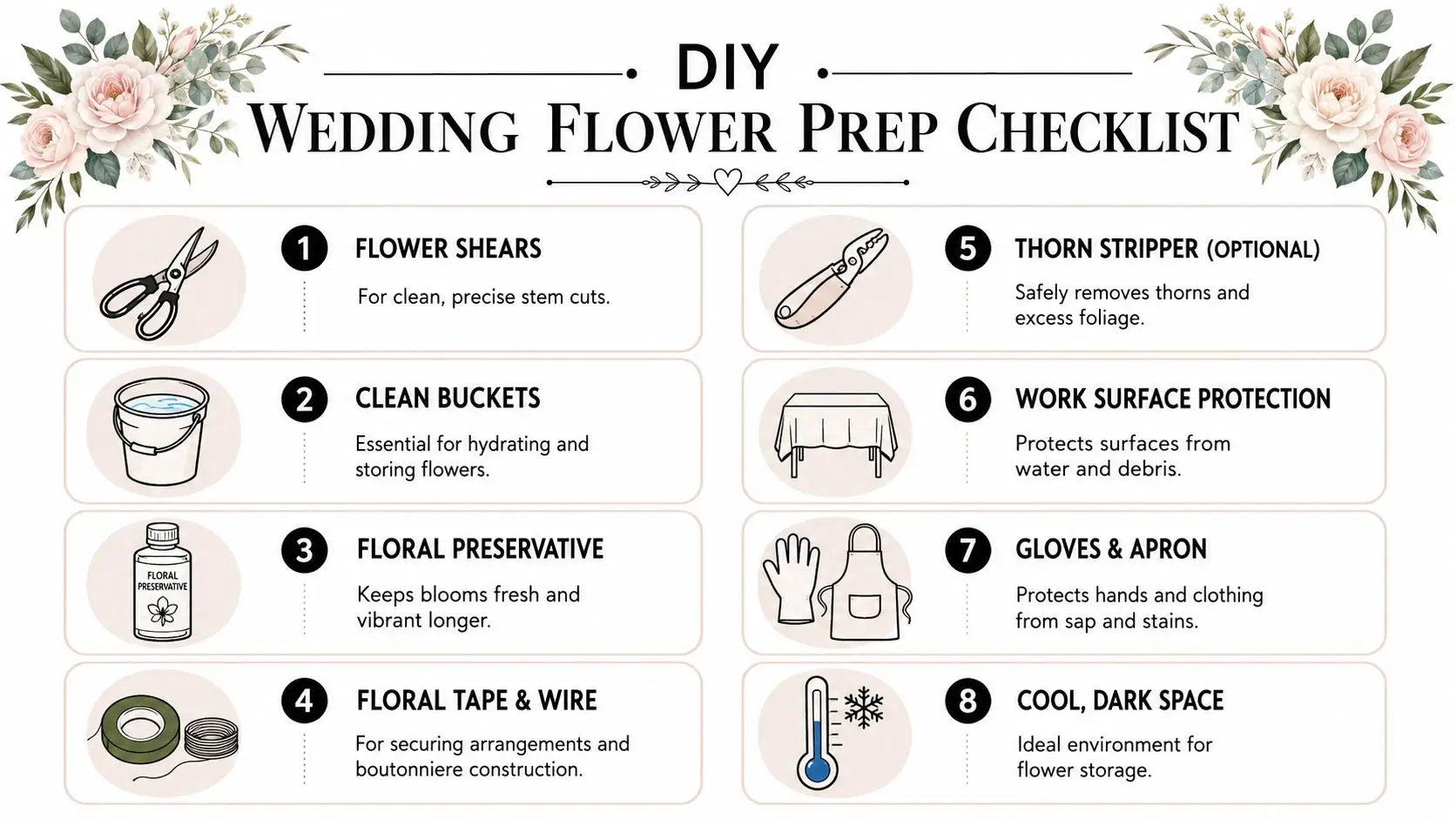
Have these supplies laid out and easy to grab:
- Sharp flower shears: Dull scissors crush stems and slow water uptake.
- Plenty of clean buckets: You need more than you think, especially if you're separating focal flowers, greenery, and delicate blooms by type.
- Floral tape and wire: Keep these nearby for boutonnieres, corsages, and emergency repairs.
- Table protection or towels: Prep gets wet fast, and pollen can stain.
- Apron and gloves: Useful for thorny roses, sticky sap, and messy foliage.
- A cool, dark holding area: A basement, spare room, or venue cooler usually works better than a busy kitchen.
One practical note that DIY guides often skip. Bucket count affects labor. If six flower varieties arrive and you have only three usable buckets, someone will waste precious time washing containers while the flowers sit dry on the floor.
Condition flowers the minute they land
The first job is hydration, not arranging. As noted in Confetti Daydreams' storage guidance, wedding flowers are best delivered about two days before the event, given several hours to rehydrate in clean water, and kept away from household fridges that also store produce because produce releases gases that can shorten vase life and interfere with bloom performance.
That timing matters because conditioning takes longer than beginners expect. Unboxing, sorting, stripping leaves, recutting stems, and getting every variety into water can easily eat up a few solid hours, especially if only one or two people are doing the work.
Use this arrival routine:
- Open boxes right away. Check counts and flower condition before anything else competes for your attention.
- Fill buckets first. Clean, cool water should be ready before stems are fully unwrapped.
- Strip anything below the water line. Leaves left underwater foul the bucket quickly.
- Recut stems. A fresh angled cut helps flowers drink after shipping.
- Sort by variety and condition. Damaged stems go in a separate bucket so they don't slow down the whole team.
- Let flowers rest. Many blooms look tired after transit and improve noticeably once they drink undisturbed.
Assign jobs if you have helpers. One person opens and checks boxes. One trims and strips. One places stems into labeled buckets. That simple division prevents the common prep-table jam where everyone reaches for the same pile and nothing moves efficiently.
Flowers often look disappointing straight out of the box. That alone is normal. Trouble starts when tired stems are forced into designs before they have recovered.
Store flowers without hurting them
Cool and stable beats cold and chaotic. A family refrigerator sounds sensible, but it often creates problems because of produce, frequent door opening, cramped shelves, and uneven airflow.
Store flowers in a space that is:
- Cool
- Dark
- Away from fruit and vegetables
- Away from direct sun and heat vents
- Quiet enough that buckets won't be bumped or moved repeatedly
A basement or cool spare room can work well if the temperature holds steady. A venue cooler can be even better, but confirm access times in advance so your flowers are not trapped behind a locked kitchen door on setup day.
Keep bulk stems unarranged while they condition. Finished bouquets and centerpieces drink less efficiently than loose stems in clean buckets, and tight designs trap bruised petals and broken foliage where you may not notice them until much later.
Clean water also matters more than people expect. If a bucket turns cloudy, change it. If leaf bits collect at the bottom, rinse and refill. Dirty buckets shorten flower life fast, and that kind of failure usually shows up at the worst possible moment.
Assembling Your Arrangements Like a Pro
Design gets much easier once you stop thinking in terms of “making something pretty” and start thinking in terms of shape, balance, and stem jobs. Every flower in a good arrangement is doing one of four things: anchoring the design, adding texture, creating line, or supporting the whole structure with greenery.
That's why professional-looking diy wedding flowers often come from simple formulas repeated well.
Use a bouquet recipe instead of guessing
For a standard 9 to 10 inch bridal bouquet, expert guidance from FiftyFlowers' bouquet stem guide recommends 25 to 30 total stems, made up of 8 to 10 focal flowers, 8 to 10 filler flowers, 4 to 6 line flowers, and 5 to 6 greenery stems. That recipe gives you presence without overcrowding.
If you're new to bouquet making, don't freestyle your stem count. Build in layers:
- Greenery first: Set the outline and width.
- Line flowers next: Create movement and directional shape.
- Focal blooms after that: Space them so the eye travels, instead of clumping them into one heavy lump.
- Filler last: Tuck texture into gaps and soften transitions.
A bouquet should look generous from the front, but not like it swallowed your wrists. If the head feels too heavy or the stems are fighting each other, you've probably overfilled the center.
Learn the spiral hand position early
The spiral technique matters because it gives the bouquet internal order. According to the Millennial Boss diy flower tutorial, skipping the spiral often leaves stems pointing in random directions and can cause bouquets to collapse, while the spiral method aligns stems in one direction for structure.
Watch the hand position in motion here before you practice:
The mechanics are simpler than they look:
- Hold your first stems in one hand.
- Add each new stem at an angle, crossing in the same directional pattern.
- Rotate the bouquet as you build.
- Keep your grip at the binding point, not up near the flower heads.
- Check the silhouette every few stems.
A spiral bouquet feels awkward for the first few tries. Then your hands understand it, and everything gets easier.
Make one practice bouquet before wedding week. Not because it has to be perfect, but because your hands need rehearsal as much as your eyes do.
Keep boutonnieres and centerpieces simple
Beginners often spend all their energy on bouquets and then overcomplicate the smaller pieces. Don't.
For boutonnieres, use one small focal bloom or a small cluster, plus a touch of supporting texture and neat wrapping. If you need several, make them assembly-line style so they match.
For centerpieces, simple beats clever. A low arrangement with a repeatable shape works. So do clustered bud vases if your style is airy and relaxed. What doesn't work is giving every table a different design and expecting your helpers to maintain consistency under time pressure.
A fast quality check for any arrangement:
| Check | Ask yourself |
|---|---|
| Shape | Does it have a clear outline, or is it lumpy? |
| Balance | Are heavy blooms distributed, not crowded? |
| Movement | Does the eye travel through the piece naturally? |
| Freshness | Is every stem still well hydrated? |
| Finish | Are mechanics hidden and stems neatly trimmed? |
Your Wedding Week Flower Timeline
The final days are where good flower plans either hold or crack. Couples almost always underestimate two things: how many separate tasks floral work contains, and how tired everyone gets after a few hours on their feet.
According to Millennial Boss and Lily & Lime, successful diy execution needs a strict 2 to 3 day pre-wedding timeline, flowers should be conditioned for 12 to 24 hours, and couples often underestimate the 12 to 18 hour labor required for full decor. That labor estimate feels very real once you factor in trimming, cleanup, wiring, labeling, water changes, and transport.
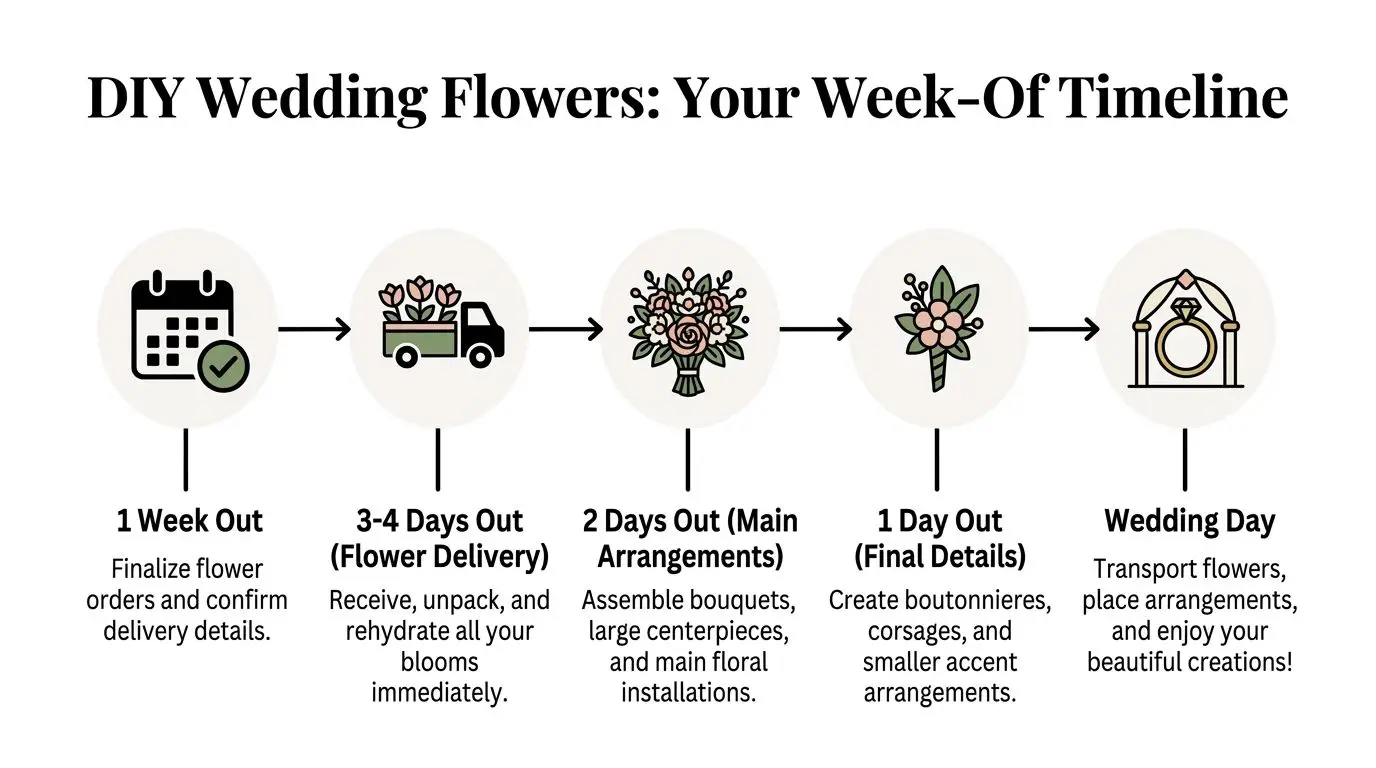
A realistic workflow for the final days
Use a workflow that matches flower behavior, not wishful thinking.
1 week out
- Confirm delivery details, containers, ribbon, tools, and workspace access.
- Print a floral checklist. A detailed wedding flower checklist helps prevent the classic problem of remembering flowers but forgetting pins, buckets, or transport boxes.
3 days out
- Clear storage space.
- Wash buckets and prep your work area.
- Brief your helpers so no one arrives asking basic questions in the middle of crunch time.
2 days out
- Receive and process flowers.
- Let them hydrate and recover.
- Do not start assembling everything the minute you're excited to touch them.
1 day out
- Make main arrangements and bouquets.
- Label pieces by recipient or table if someone else is transporting or placing them.
Wedding day
- Create the most delicate personal flowers if needed.
- Load carefully, place calmly, and stop fiddling once everything is set.
Delegate by task, not by bouquet
The biggest labor mistake is assigning everyone “some flowers.” That creates uneven quality and confusion. Assign by station.
A cleaner division looks like this:
| Role | Best tasks |
|---|---|
| Two detail-oriented people | Bridal bouquet and attendants' bouquets |
| One steady pair of hands | Boutonnieres and corsages |
| One practical organizer | Bucket water, stem cleanup, trash removal |
| One placement lead | Venue delivery and on-site setup |
| One decision-maker only | Final design approval |
Give one person authority to say when a piece is done. Too many opinions ruin speed and shape.
The final week is not the time to discover your maid of honor hates wiring flowers or your cousin cuts every stem too short.
If your wedding is large or your install work is ambitious, trim your floral plan before trimming your sanity. A simpler plan finished well always beats a grand plan half-finished at midnight.
Troubleshooting, Transport, and Preservation
Even careful couples run into problems. A bloom bruises. A boutonniere twists. A centerpiece slumps on one side. None of that means the whole floral plan is failing.
The calmer truth is that most flower emergencies are mechanical. They can be solved if you respond quickly and don't start reinventing the design in a panic.
Fix common flower problems fast
Use the least dramatic solution first.
A focal flower wilts
- Remove it and replace it with a fresh secondary bloom rather than trying to force one tired stem to carry the whole bouquet.
- If the replacement is smaller, adjust surrounding filler to rebalance the face of the design.
The bouquet looks heavy on one side
- Don't jam new flowers into the full side.
- Rotate it, remove one or two stems from the crowded area, then reinsert lighter material where the shape needs breathing room.
A boutonniere feels floppy
- Rewire if needed, then retape tightly at the binding point.
- Smaller pieces need tighter mechanics than beginners expect.
You run out of one greenery
- Match function, not species.
- If the missing greenery provided width, swap in something with similar spread. If it provided drape, use another trailing element or skip the drape entirely and tighten the design.
Most guests won't notice a substitution. They will notice stressed, overhandled flowers.
If a flower opens faster than expected, move it into the coolest safe space you have and keep it out of bright light. If a flower is still tight, give it time in water and don't force it into a finished arrangement too early.
Transport without crushing your work
Transportation is where many good diy wedding flowers get flattened. The fix is simple: design for transport from the start.
For bouquets:
- Place them upright in a small amount of water if possible.
- Use sturdy containers or crates so they can't roll.
- Never pile bags, jackets, or signage near them in the car.
For centerpieces:
- Transport low and stable pieces in boxes with towels or non-slip shelf liner around the vessel base.
- Keep plenty of air around the blooms. Tight packing prevents shifting, but it can also bruise petals.
For personal flowers:
- Keep boutonnieres and corsages in clearly labeled shallow boxes.
- Assign one person to carry and distribute them. Tiny pieces disappear fast when too many people handle them.
One practical habit matters more than almost anything else: load flowers last, unload them first. They shouldn't sit in a warm vehicle while people debate where the guest book goes.
If you want more general flower handling guidance after the wedding, Barbara's Flower Boutique LLC maintains practical resources under its cut flower care tag.
Preserve what matters after the wedding
Not every arrangement deserves long-term preservation. Your bridal bouquet usually does. A ceremony meadow piece probably doesn't. Choose the flowers tied to memory, not the flowers you feel guilty throwing away.
You have a few sensible options:
Air drying
- Best for flowers that hold shape reasonably well
- Creates a faded, romantic look rather than a fresh one
Pressing
- Better for keepsake art than for preserving bouquet form
- Lovely for a few meaningful stems or petals
Professional preservation
- Useful if the bouquet has deep sentimental value
- Worth considering if you want a framed or display-ready result
Before preserving anything, remove damaged material. A bouquet that looked beautiful on the day may still contain a few bruised petals or softened stems that won't age well. Save the strongest blooms, ribbon, or one small tied section if the whole bouquet feels too bulky to keep.
The larger point is this: perfection was never the standard. Care was. Diy wedding flowers succeed when the flowers are hydrated, the plan is realistic, and the people helping you know what they're doing. That's what keeps the work from becoming chaos. And that's what makes handmade wedding flowers feel personal in the best way.
If you're gathering stems, tools, or practical flower care guidance for your own diy wedding flowers, Barbara's Flower Boutique LLC is one option for cut flowers ordered online and shipped with FedEx, with customer-paid shipping.
Discover more from Barbara's Flower Boutique
Subscribe to get the latest posts sent to your email.