
You're probably in one of two situations right now. You either need flowers for a wedding or event and want wholesale pricing without sacrificing quality, or you're a small florist trying to source reliable stems without access to a traditional wholesale truck route.
A challenging truth about wholesale cut flowers emerges. Buying the flowers is only half the job. The critical work is protecting them from harvest to doorstep, then from doorstep to design table. If the cold chain breaks, if the box sits outside, if the buckets are dirty, if the stems don't get conditioned fast, the flowers tell on you.
For florists with warehouse access, cooler space, and established wholesale relationships, these steps are standard operating procedure. For DIY couples and small studios receiving boxes by FedEx, the same rules still apply. You just have to translate commercial practice into home-scale discipline.
Table of Contents
- How to Find and Vet Your Wholesale Flower Supplier
- Decoding Wholesale Pricing Minimums and Quality Grades
- Calculating Stem Counts for Your Wedding or Event
- Navigating Wholesale Shipping and Cold Chain Logistics
- Flower First Aid The First 24 Hours After Delivery
- Your Wholesale Flower Timeline and Final Pro Tips
How to Find and Vet Your Wholesale Flower Supplier
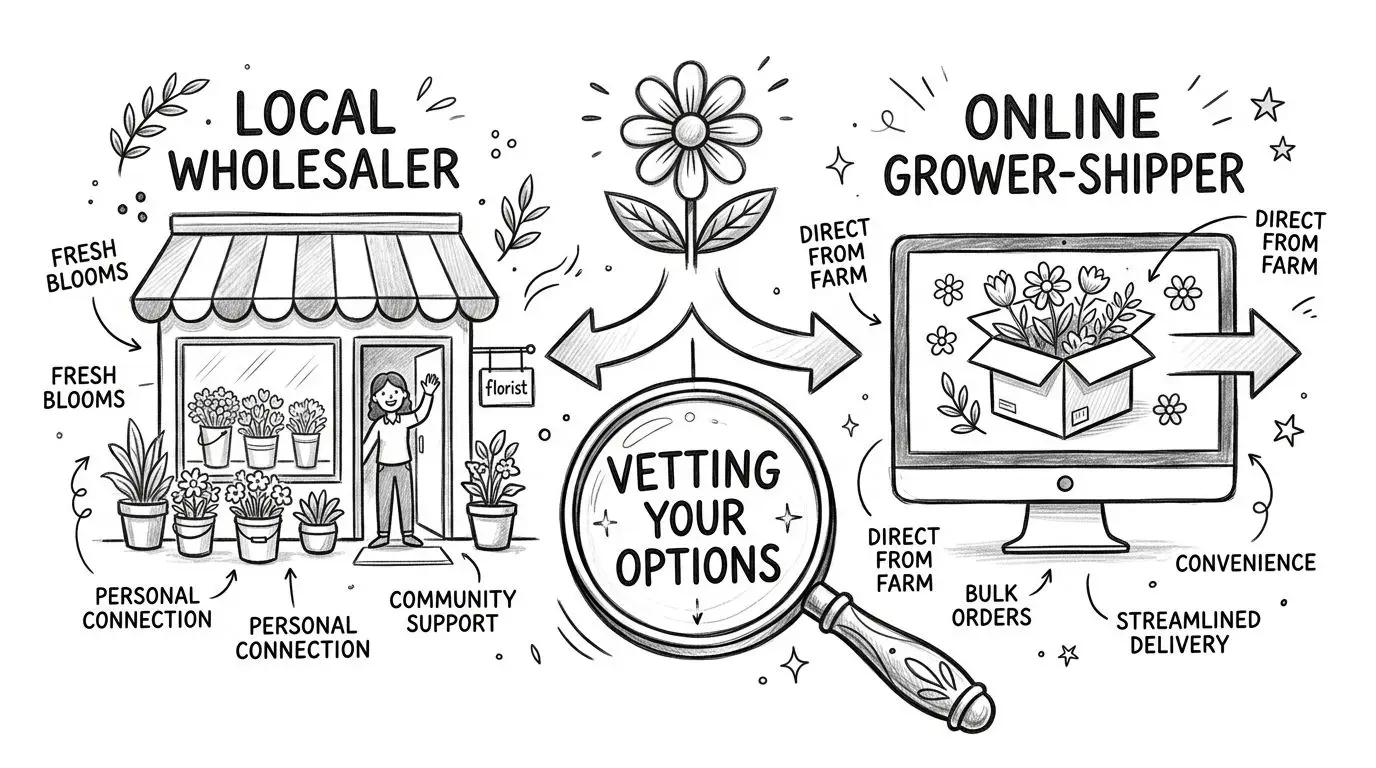
The first decision is simple on paper and messy in real life. You can buy from a local walk-in wholesaler or from an online grower-shipper. Which one makes sense depends on your location, your event size, and how much information the supplier is willing to share.
Local wholesaler or online grower-shipper
A local wholesaler gives you one big advantage. You can often see product in person, inspect stem condition, and ask direct questions before loading your order. That matters if you know how to judge maturity, hydration, bruising, and whether bunches have been sitting too long.
An online grower-shipper solves a different problem. The U.S. market has about 500 wholesale distributors for over 12,000 retail florist shops, which creates real supply gaps outside major hubs, according to North Carolina State University industry research. Online suppliers fill that gap, but they can also be opaque about farm origins and cold-storage practices.
Practical rule: If a supplier won't clearly answer basic sourcing and handling questions before purchase, don't expect better communication after a shipping delay.
That doesn't mean online sellers are a bad choice. It means you need to vet them like a buyer, not browse them like a gift shopper.
What to ask before you place an order
A solid supplier should answer practical questions without getting slippery. Ask these before you commit:
- Where are the flowers coming from. Farm-grown in-house, brokered through a distributor, or mixed sourcing.
- When are the flowers harvested. You want a clear answer about timing, not vague language about “fresh from the farm.”
- How are they packed and stored. Especially whether they move through cooled handling and whether they ship dry or hydrated.
- What happens if the box is delayed. You need to know their process, not just their refund language.
- Can they explain variety-specific handling. Fragile flowers should get a different answer than hardy flowers.
Credentials help, especially when you can't inspect in person. Membership in the Association of Specialty Cut Flower Growers and Better Business Bureau certification don't replace good handling, but they do show that a business is operating in the open. Barbara's Flower Boutique LLC is one example of an online cut flower seller that states those credentials and ships with FedEx while the customer pays shipping.
A product listing can also tell you something about whether a seller understands stem-level buying. For example, twenty-five celosia stems is presented as a stem-counted item, described as a striking collection of 25 plumed celosia stems with jewel-toned blooms, listed at $50.00. That kind of listing is more useful to event buyers than vague bouquet language because it helps you plan design mechanics and quantity.
Use the conversation to judge whether the supplier thinks like a florist, grower, or fulfillment warehouse. The closer they are to the flowers, the better the answers usually are.
Decoding Wholesale Pricing Minimums and Quality Grades
A florist prices out a wedding, sees a low per-bunch number, and assumes the flower budget is under control. Then the order lands. The roses only come in full-box increments, the lisianthus bunches are lighter than expected, and a chunk of the stems are cut too open for a Saturday event. That is how a cheap order turns expensive.
Wholesale flower pricing makes sense once you stop looking at the first number and start looking at the pack size, stem count, grade, and shipping method together. For buyers using FedEx or similar carriers instead of a refrigerated floral truck, those details matter even more because every extra box, every loose pack, and every overmature stem adds risk in transit.
What the minimum really means
Suppliers sell in a few common formats: bunches, assorted bunch packs, quarter boxes, half boxes, and full boxes. The minimum is not just a sales rule. It usually reflects how the farm or importer packed the flowers for cold storage and outbound shipping.
Here is the practical difference:
| Ordering format | What it usually means for the buyer | Main trade-off |
|---|---|---|
| Bunch | Good for testing color or filling a small recipe gap | Highest handling cost per stem |
| Quarter or half box | Better unit price without committing to a full case | Fewer varieties and grades available |
| Full box | Best price structure on many staple flowers | Greater waste risk if your counts are off |
A full box often looks like the best deal on paper. It is a bad deal if you only need sixty stems and have to buy one hundred or more. Extra stems are not free inventory. They take cooler space, labor, buckets, solution, and design time. If the event is small, they can turn into compost.
This is one reason I tell DIY wedding buyers to compare prices by usable stem, not by listed bunch. If one supplier offers a lower number but requires larger case quantities, your real cost may be higher before the flowers even leave the cooler. A planning sheet like this wedding flower checklist for events and personal flowers helps catch that before you order.
Grade affects both design quality and shipping survival
Quality grades are not standardized perfectly across the industry, so you have to read the listing with some skepticism. Still, the same patterns show up over and over. Better grades usually mean more consistent stem length, stronger necks, cleaner foliage, and a tighter harvest window. Lower grades may still be usable, but they tend to need more sorting and more culling.
For event work, consistency saves real money.
Ten bunches of roses that open at roughly the same stage are faster to process and easier to design with than ten mixed-stage bunches that need to be separated across multiple buckets. The same goes for focal flowers shipped nationwide. Stems that are too tight may miss the event window. Stems that are too open bruise faster, shatter in the box, and have less vase life after a two-day carrier trip.
Watch for these quality signals in the product description or in your pre-order questions:
- Stem length listed as a range or a fixed grade
- Bloom stage described for shipping, not just for photos
- Bunch counts that specify stems per bunch instead of vague pack language
- Notes about petal guard, sleeving, or protective wrap on fragile blooms
- Clear substitution policy for color and farm source
“Farm fresh” does not tell you enough. “40 cm, 25 stems, shipped tight” tells you something you can use.
The cold chain changes how you should judge value
A traditional wholesaler delivering on its own truck can sometimes absorb minor packing flaws that a parcel carrier will punish. FedEx boxes get scanned, stacked, sorted, and moved through multiple handoff points. Flowers shipped that way need tighter prep and smarter buying.
That changes the pricing conversation.
A slightly higher-priced bunch from a supplier who pre-cools properly, packs to reduce head movement, and ships at the right cut stage often performs better than a cheaper bunch that was packed warm or cut too open. Small florists and DIY buyers do not have much margin for shipping loss. If five stems per box arrive bent, broken, or blown open, the savings disappear fast.
I look at wholesale value through four questions:
- How many stems in the box are likely to be event-usable?
- How much labor will it take to sort, strip, and cull them?
- How well will that variety tolerate two days in parcel transit?
- What is my backup plan if the carrier is late?
That is the commercial mindset worth borrowing. Buy flowers that can survive the trip you are using, not the trip you wish you had.
Cheap flowers with inconsistent grade usually show up later as labor, waste, and last-minute substitutions.
Pricing traps that catch new buyers
Mixed-box offers can be useful, but they sometimes hide weak stem counts or second-choice varieties. Assorted packs also make recipe planning harder if one component runs short.
Reflexed roses in the product photo can create another problem. A supplier may be showing a design-stage look, while the shipped product arrives much tighter. That is normal. What matters is whether the flowers can open on schedule after processing.
The safest question is simple: ask what condition the flowers are packed in, how many stems are in each unit, and what grade or harvest stage you should expect on arrival. If the answer is vague, price is the wrong thing to focus on.
For weddings and events, buy with the box, the cooler, and the carrier route in mind. That is how wholesale numbers start to mean something useful.
Calculating Stem Counts for Your Wedding or Event
You do not feel a bad stem count when you place the order. You feel it the night before the event, with open boxes on the floor and one recipe eating flowers faster than expected.
That problem usually starts with planning from photos instead of from pieces. An inspiration image can tell you style, color, and proportion. It cannot tell you how many centerpieces you need to finish, how many stems each bouquet will consume, or which flowers are likely to be too tight, too open, or too bruised to use in a personal piece after parcel shipping.
Build your count from finished pieces
Start with a written item list. Count every bridal bouquet, attendant bouquet, boutonniere, corsage, centerpiece, bud vase, ceremony arrangement, cake cluster, and extra accent piece. Then assign each item a stem recipe.
I use three working categories because they keep the math clean:
- Focal stems that carry the visual weight
- Secondary or filler stems that add texture, spacing, or color support
- Greenery or line material that gives shape, movement, and coverage
This matters for shipped wholesale flowers because not every stem arrives equally useful. A bunch of hardy greens may be fine for coverage even if a few tips are rough. Focal flowers do not give you that margin. If six premium blooms arrive bruised or open too fast, your bouquet count changes immediately.
If you want one place to track personals, ceremony pieces, and reception flowers, keep a copy of this wedding flower checklist alongside your stem worksheet.
Sample stem count worksheet
Build the order on paper before you build it in buckets.
| Arrangement Type | Focal Stems | Filler Stems | Greenery Stems |
|---|---|---|---|
| Bridal bouquet | |||
| Bridesmaid bouquet | |||
| Boutonniere | |||
| Low centerpiece | |||
| Medium centerpiece | |||
| Bud vase cluster |
A practical method is to total by arrangement first, then by flower variety. That keeps one flower from getting assigned to five jobs without you noticing.
Here is a real-world way to check the math. A bridal bouquet may need a protected group of your best focal stems, because that piece has no room for compromised product. Centerpieces can absorb more variation, especially if your recipe uses supportive flowers and greenery well. Bud vases are often the safety valve. They let you use shorter stems, singles, and leftovers that would look weak in a hand-tied bouquet.
Add the buffers that wholesale buyers actually need
Raw stem math is only the starting point. Shipped flowers need margin for handling, conditioning, and loss.
Account for these factors before you place the order:
- Culling loss. Some stems will be bent, bruised, or too open for the job you planned.
- Processing loss. A few stems can snap while you strip foliage, recut, or hydrate.
- Timing risk. Tight flowers may not open on your schedule. Fast flowers may move too far by design day.
- Recipe drift. Large bouquets and lush centerpieces almost always consume more than the first draft suggests.
I tell newer buyers to protect the pieces that matter most, then let the easier pieces carry the substitutions. Personal flowers need your best stems. Reception work gives you more room to adjust.
Your first count is a draft. The useful count is the one you revise after you match each flower to a specific job and allow for shipped-product loss.
The goal is not perfect math. The goal is to finish the event with enough flowers in the right grades, at the right stage, without paying for boxes of stems you cannot use.
Navigating Wholesale Shipping and Cold Chain Logistics
A shipped flower order lives or dies by one thing. Temperature control. Not branding, not packaging copy, not whether the tracking page says “on time.”
For DIY couples and small florists, this is the least understood part of buying wholesale cut flowers nationwide. That's a problem because specialty flowers with shorter vase life or weak transport durability need careful handling, and many consumer-facing guides don't explain the cold chain well. The practical benchmark for delicate blooms is keeping flower-head temperatures below 6°C (43°F) and dry storage near 1°C (34°F), as outlined in Utah State University's cut flower industry research.
What happens before the box reaches you
The box starts in the field or packing area, not on a truck. Good handling begins with harvest during the coolest part of the day, immediate pre-cooling, careful packing, and time spent in controlled conditions instead of warm staging areas. That's commercial discipline, but the principle is simple enough for any buyer to understand. Heat removed early is easier to manage than heat trapped in a closed carton.
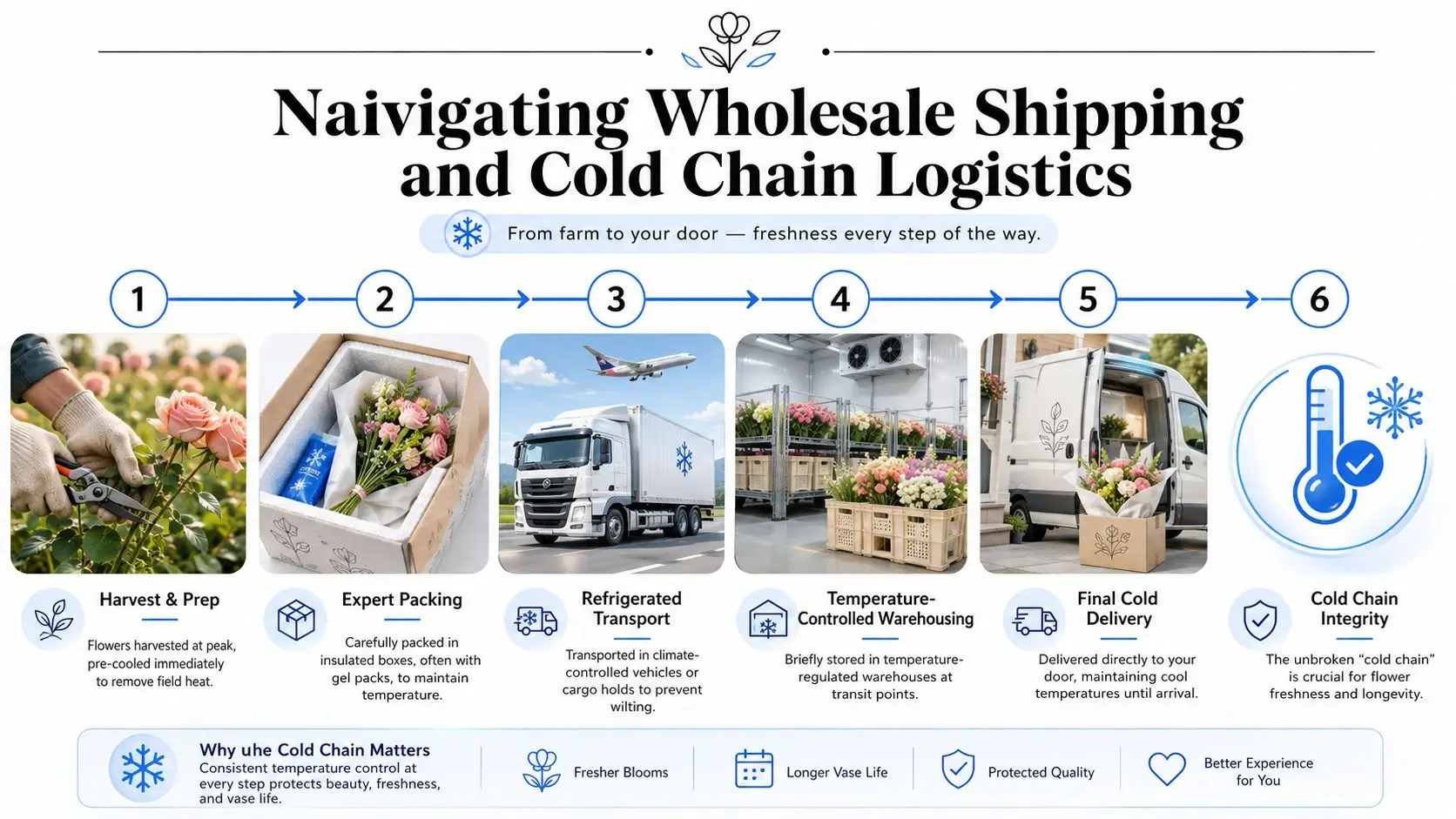
When flowers move through carriers like FedEx, your order may pass through vehicles, hubs, and short-term holding points. Every handoff introduces risk. Fragile flowers don't care whether the delay came from weather, routing, or a missed scan. They only register temperature and time.
That's why I tell buyers to stop thinking of shipping as “delivery” and start thinking of it as a relay race. Every hour matters more once the flowers leave the farm.
What you need to do on delivery day
The tracking number isn't just for curiosity. It's part of your handling plan. If you know the box is out for delivery, someone needs to be available to receive it. A shaded porch is not a cooler. A locked office is not a cooler. A hot vehicle is definitely not a cooler.
Use this delivery-day checklist:
- Watch the final scan window so the box isn't left sitting.
- Clear cooler or bucket space in advance before the driver arrives.
- Open immediately and check general condition.
- Separate fragile stems first so they can hydrate and recover without delay.
A lot of first-time buyers assume boxed flowers can wait because they look packed well. They can't. Packaging buys time. It doesn't cancel biology.
Flower First Aid The First 24 Hours After Delivery
The first 24 hours decide whether your flowers perform like event product or fade like grocery leftovers. Once the box is in your hands, speed matters, but panic doesn't help. Work clean, work cool, and do things in the right order.
To make the sequence easier to follow, keep this visual guide nearby while you process stems.
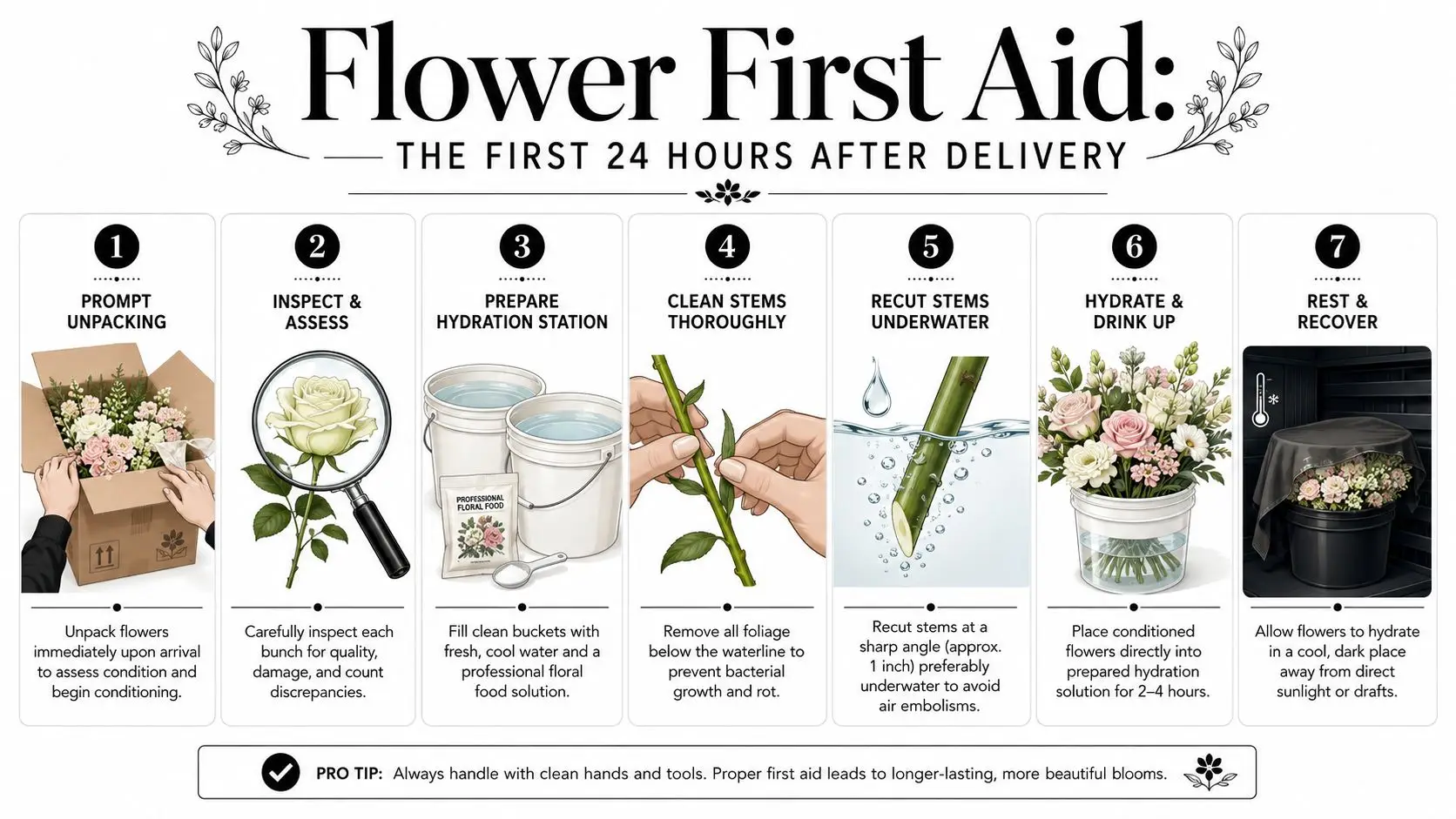
Open inspect hydrate
Professional wholesalers treat receiving like quality control, not like unboxing. Floral handling guidance for wholesalers says flower-head temperatures should be maintained at or below 6°C (43°F), and when boxes arrive, staff should randomly inspect several boxes with a needle thermometer. If readings exceed that threshold, box tops should be removed immediately for rapid cooling. The same guidance warns that mistakes like using non-chilled water can reduce freshness by 30 to 50%, according to FloraLife's wholesaler best practices.
For small studios and home buyers, the exact tool kit may be simpler, but the receiving mindset should be the same.
Start here:
- Open the box right away.
- Inspect bunches for obvious heat stress or damage.
- Get clean buckets ready before you start trimming.
- Move flowers into cool conditions as quickly as possible.
If you want more practical handling guidance after unboxing, this collection of cut flower care articles is a useful next read.
Here's a quick demonstration that pairs well with the checklist above.
The conditioning routine that protects vase life
Conditioning is not decorative prep. It's recovery work. Flowers need clean water, food, trimmed stems, and time to drink in a cool space before you design with them.
Use this routine:
- Use spotless buckets because bacteria in dirty containers shuts stems down fast.
- Strip foliage below the waterline so leaves don't rot in the bucket.
- Recut stems to reopen uptake.
- Use a proper hydration solution instead of plain warm tap water and hope.
- Let them rest before arranging so they can regain turgor and stabilize.
If flowers arrive tired, don't start designing to “see what you've got.” Hydrate first. Design later.
One of the most common mistakes I see is people spreading all the flowers across tables, sorting colors, and chatting through the process while nothing is drinking. That's arrangement theater, not flower care. Get them into solution first.
Your Wholesale Flower Timeline and Final Pro Tips
Good flower work looks graceful on event day because the timing was disciplined beforehand. The best wholesale orders don't happen at the last minute, and the smoothest delivery days are the ones that were planned backward from the event date.
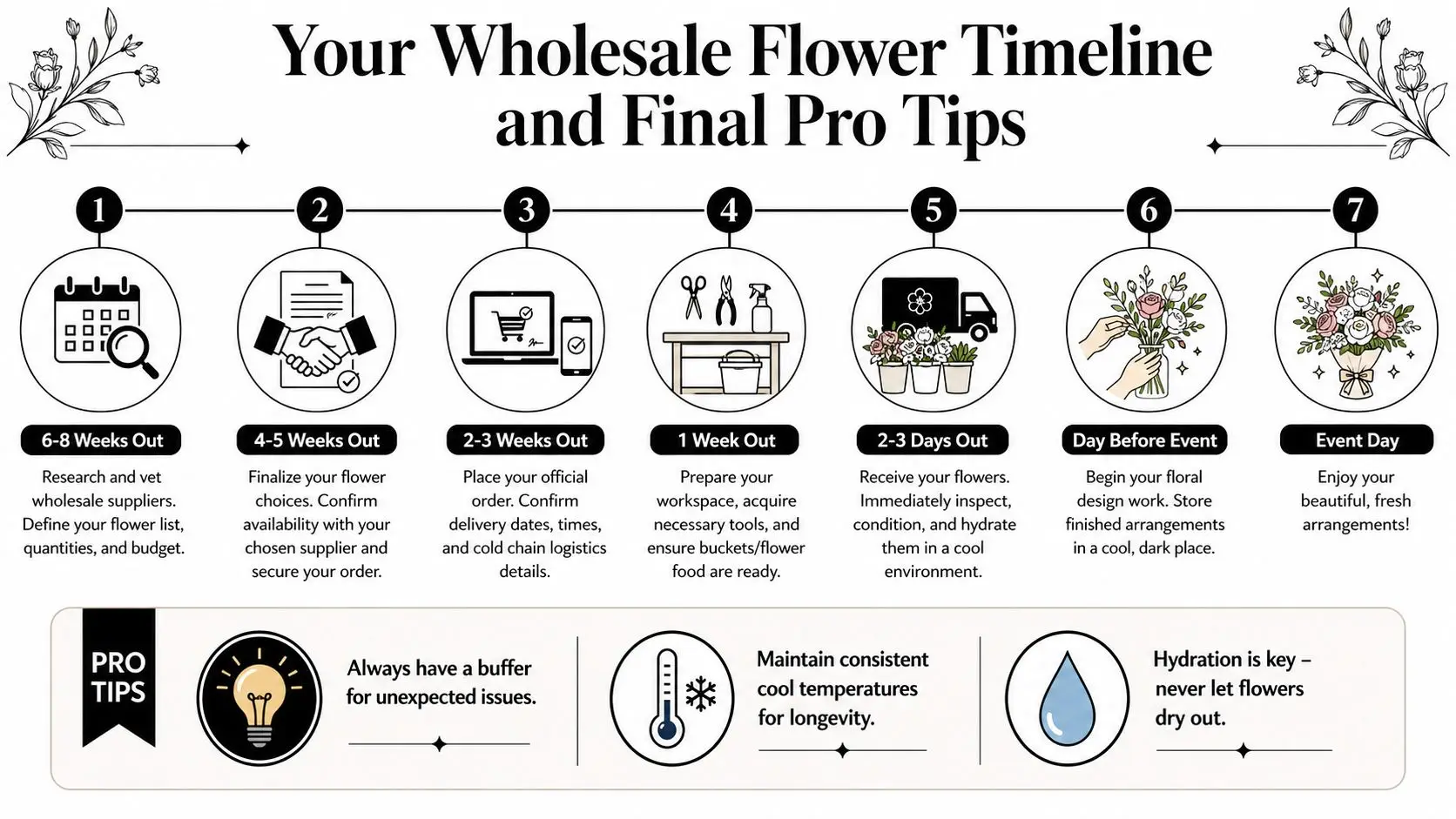
A working timeline for florists and DIY buyers
Use a simple calendar structure and assign actual tasks to each point.
| Timing window | What to do |
|---|---|
| 6 to 8 weeks out | Research suppliers, define flower list, decide what must be shipped versus sourced locally |
| 4 to 5 weeks out | Confirm availability, packaging style, shipping method, and receiving plan |
| 2 to 3 weeks out | Place the order, verify delivery details, and assign who will receive boxes |
| 1 week out | Prep buckets, tools, workspace, recipes, and backup vessels |
| 2 to 3 days out | Receive, inspect, condition, and hydrate flowers |
| Day before | Design core pieces and store them cool |
| Event day | Finish personals, install carefully, and protect from heat |
If you're planning your own event flowers, this guide to DIY wedding flowers fits naturally into this timeline.
Pro tips for florists and planners
Professionals usually struggle less with arranging and more with scaling. Volume creates its own problems.
- Build vendor memory. Keep notes on stem quality, substitutions, packaging style, and how each supplier handles communication.
- Protect your receiving window. Don't schedule installs that clash with inbound box arrivals.
- Translate risk to clients early. If a variety is fragile or travel-sensitive, say that before mood boards become promises.
- Stage in cool conditions whenever possible. Commercial guidance is clear that protocol matters as much as infrastructure. Teams get consistent results when they properly follow cooling and handling systems, not when they assume the cooler alone will save the product.
A florist who buys regularly should also think in categories: dependable staples, seasonal stars, and high-risk specialty stems. Those groups don't belong in the same planning bucket.
DIY tips for couples and first-time buyers
DIY buyers usually make one of two mistakes. They either choose flowers that are too delicate for their experience level, or they underestimate the labor after delivery.
Here's what works better:
- Choose forgiving flowers for your first event. Save the most temperamental blooms for accents, not for every arrangement.
- Keep recipes repetitive. Repeating one or two centerpiece formulas is easier than making every table different.
- Recruit help for processing, not just arranging. The busiest part comes when the boxes arrive.
- Give yourself a cool room and a clear table. Floral work goes sideways fast in cluttered, warm spaces.
- Don't schedule your entire flower workload for one evening. Spread processing, hydration, and arranging across realistic blocks of time.
Wholesale flowers reward preparation. They punish improvisation.
That sounds strict, but it's good news. You don't need a giant warehouse to succeed. You need a realistic design plan, a supplier you've vetted, a delivery day you control, and the discipline to treat flowers like the perishable material they are.
If you do that, shipped wholesale cut flowers can absolutely work for weddings, events, and small studios. Not because shipping is easy, but because the flowers were handled correctly at every step that mattered.
Barbara's Flower Boutique LLC offers cut flowers online for florists, wedding organizers, event planners, and DIY couples, with orders shipped by FedEx and shipping paid by the customer. If you need a source for event stems and want to review product details, sourcing format, and educational guidance in one place, visit Barbara's Flower Boutique LLC.
Discover more from Barbara's Flower Boutique
Subscribe to get the latest posts sent to your email.