You're probably in one of two places right now. You're either a florist trying to move beyond the same dependable stems everyone else can order by the box, or you're planning an event and staring at product photos online, wondering which flowers will arrive with the color, form, and presence you're paying for.
That's where specialty cut flowers become more than a pretty category. They become a sourcing decision, a logistics decision, and often the difference between an arrangement that feels generic and one that feels composed.
For florists, planners, and ambitious DIY couples, the challenge isn't just finding unusual flowers. It's knowing how to identify them, when to buy them, how to handle them, and how to avoid spending premium money on stems that were marketed well but packed poorly.
Table of Contents
- Beyond the Basics An Introduction to Specialty Flowers
- What Distinguishes a Specialty Cut Flower
- A Seasonal Guide to Common and Rare Varieties
- How to Source and Verify Quality Flowers
- Shipping and Handling Best Practices Explained
- Conditioning and Care for Extended Vase Life
- Designing and Pricing with Specialty Blooms
- Frequently Asked Questions
Beyond the Basics An Introduction to Specialty Flowers
A florist scrolls through page after page of roses, carnations, and filler greens, then stops when something finally has movement. Maybe it's a ruffled lisianthus with painterly color. Maybe it's a dinnerplate dahlia that looks almost unreal. Maybe it's a stem of celosia with so much texture it changes the whole arrangement.
That moment is usually the beginning of someone's interest in specialty cut flowers. They don't read like commodities. They read like choices with character.
These flowers matter because they solve a design problem. They add shape where a bouquet feels flat, texture where a centerpiece feels predictable, and seasonality where an event needs to feel grounded in a real time and place. Couples planning DIY weddings often want exactly that. They aren't looking for the most standard option. They want flowers that feel personal, local, or less conventional.
That demand is part of a sizable market. The global specialty cut flower market was valued at USD 39.74 billion in 2025, reflecting how important this segment has become for events and eco-conscious floral buying, especially as DIY wedding demand grows, according to Fortune Business Insights on the specialty cut flower market.
Specialty flowers don't just decorate a table. They set the tone for the whole event.
The practical side matters too. Specialty stems often need better timing, gentler handling, and more honest communication between seller and buyer. When that happens, they're worth every bit of the extra planning.
What Distinguishes a Specialty Cut Flower
A florist placing a wholesale order usually spots the difference fast. One bucket is full of stems that behave predictably and cover the basics. Another holds flowers that need a specific harvest stage, a shorter selling window, and a buyer who knows why they are worth the extra effort. That second group is where specialty cut flowers sit.
Why commodity and specialty are not the same conversation
Commodity flowers are built around consistency, shipping strength, and broad availability. Specialty flowers are usually selected for character first. That character may come from an unusual cultivar, a fragile petal texture, a branching habit, a scent, or a color that does not show up in standard box-store mixes.
The trade-off is real. Specialty stems often cost more to grow, bruise more easily, and disappear between seasons. In return, they do design work that standard flowers often cannot do on their own. They create movement, shift the palette, or give an arrangement a point of view.
That distinction shows up in customer expectations too. Florists buying for editorial work, weddings, and custom installations are often willing to accept some natural variation if the flowers arrive with strong color, good maturity, and presence. Buyers planning their own event need that explained clearly, especially with flowers that open quickly or have a shorter vase life.
The traits that usually signal specialty status
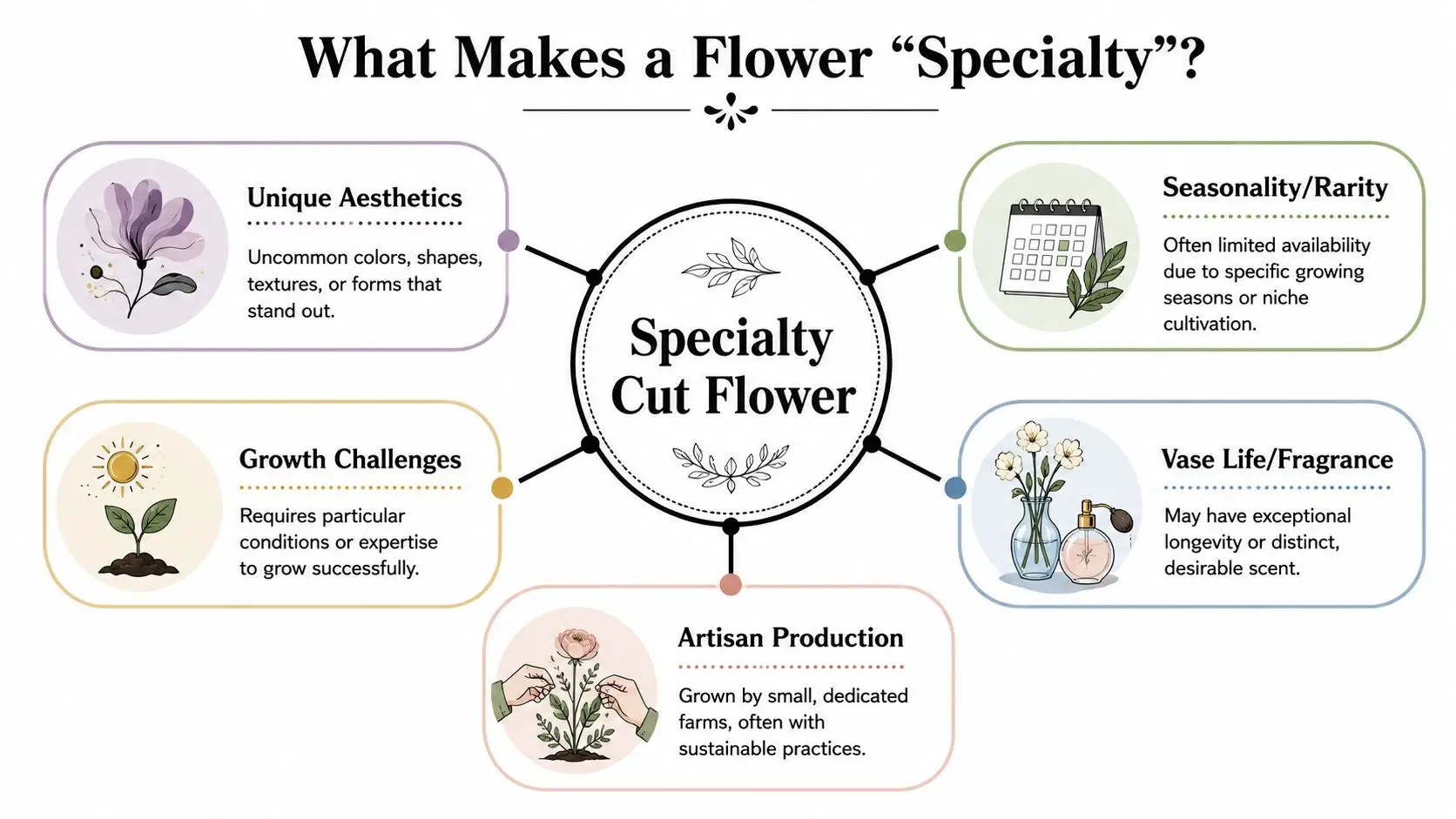
A flower usually earns specialty status through a mix of visual character, crop difficulty, and design usefulness rather than simple rarity.
- Distinct form: Ruffles, branching stems, airy movement, sculptural pods, reflexed petals, and unusual centers all push a flower into specialty territory.
- Color complexity: Specialty varieties often offer smoked tones, earthier shades, and layered color that reads differently in natural light than standard florist hues.
- Short seasonal windows: Some of the best stems are available for a brief stretch and are at their best only within that window.
- Production sensitivity: Stem length, straightness, petal quality, and vase performance often depend on tighter growing and harvest decisions.
- Design impact: These flowers contribute structure and mood. They are not just filler.
Growers see this in the field long before a florist sees it in a bucket. Some crops need support netting, careful spacing, and exact harvest timing to produce saleable stems. Others are productive but inconsistent, which is why two bunches of the same flower can look very different depending on who grew them and when they were cut.
Practical rule: If a flower only looks good after smart cultivar selection, correct harvest stage, and careful handling, it belongs in the specialty conversation.
A simple product example makes the point. twenty-five celosia stems show why celosia is often sold as a specialty cut flower. The plume shape, saturated color, and strong texture change the composition instead of disappearing into it.
The same judgment applies to more debated stems. Poppies, for example, can be excellent for the right work, but only if the buyer understands their stage, movement, and vase life. This guide on whether poppies are good cut flowers covers the kind of handling detail that separates a beautiful result from a disappointing one.
A Seasonal Guide to Common and Rare Varieties
A July wedding order can look perfect on paper and fall apart in practice if the flower list ignores the season. I see this most often with buyers who choose by photo first, then try to force a spring stem into summer service or expect a heat-sensitive flower to travel like a hardy crop. Seasonal buying is not just about price. It affects color quality, stem strength, replacement risk, and how confidently you can design once the box arrives.
Seasonal Availability of Popular Specialty Cut Flowers
| Flower | Peak Season |
|---|---|
| Ranunculus | Spring |
| Fritillaria | Spring |
| Sweet Peas | Spring |
| Zinnias | Summer |
| Celosia | Summer |
| Cosmos | Summer |
| Dahlias | Autumn |
| Marigolds | Autumn |
| Hellebores | Winter |
| Flowering branches | Winter |
Spring
Spring flowers reward close attention because many of them are beautiful and perishable at the same time. Ranunculus is one of the strongest examples. Good stems have clean petal formation, a straight neck, and enough maturity to open after hydration without arriving blown.
Sweet peas bring scent, softness, and movement that formal flowers cannot fake. They are excellent for personals, centerpieces, and any design where a little motion matters more than rigid structure. Their weakness is fragility, especially if they are packed warm or held too long.
Fritillaria sits on the rarer side of spring demand. Florists who know how to use it love the shape and the nodding habit. Clients do not always ask for it by name, but they notice the arrangement feels more individual.
Spring also invites experimentation, but not every stem behaves well in event work. Buyers considering poppies should read this guide on whether poppies are good cut flowers for arrangements and events before adding them to a recipe.
Summer
Summer gives the widest range of usable specialty material, but the quality spread is also wider. Heat, harvest timing, and hydration discipline show up fast in the bucket.
Zinnias are one of the most useful summer flowers when they are cut at the right stage. Strong zinnia stems hold color well, cover a lot of visual space, and suit everything from market bouquets to bright event work. Poorly cut zinnias go soft quickly, so buyers should expect variation between growers and ask how mature the stems are before shipping.
Cosmos adds air and looseness. It is valuable in garden-style design, but it does not replace a structural flower. Celosia does the opposite. It brings density, texture, and shape, whether you use plume forms or crested forms. Sunflowers, especially branching or less standard cultivars, can read polished rather than rustic if the center is tight and the stem is proportionate.
Summer is also the season where buyers overorder novelty and underorder support flowers. A better recipe starts with one dominant form, one airy stem, and one texture crop that can handle the weather.
Autumn
Autumn is the season that turns many occasional buyers into dahlia people. The range is hard to beat. Dinnerplate types create scale fast, while smaller ball and decorative forms give better control for bouquets and centerpieces.
Dahlias are worth the trouble, but they do require judgment. Some varieties ship well enough for local and regional work. Others bruise easily, shatter if handled roughly, or open too far before the event date. I treat dahlias as a flower to buy from someone who knows their varieties, not just someone who has them available.
Marigolds deserve more use than they get in mainstream event recipes. The better forms bring saturated color and a full, almost upholstered texture that reads especially well in late summer and fall palettes. Celosia keeps earning its place here too, especially with bronze, rust, plum, and gold schemes.
Autumn designs improve when you mix flower forms instead of repeating the same rounded bloom. Dahlia with celosia, marigold with airy filler, and branches with pods or grasses give depth without making the arrangement feel heavy.
Winter
Winter flowers ask for restraint and good sourcing. There are fewer choices, so each stem has to carry more design weight.
Hellebores have a quiet, high-end look that works in personal flowers and low arrangements. They can be temperamental as cut stems, so stage and conditioning matter more than buyers expect. Flowering branches bring line, movement, and scale when focal blooms are scarce. Paperwhites and other bulb flowers add fragrance and freshness, which can be useful in winter interiors that need life without visual clutter.
The best winter recipes are often the simplest ones. A few well-chosen stems with strong line and good posture usually outperform an overcrowded mix.
- For weddings: Start with what is naturally strong in that month, then build the palette around it.
- For florists: Choose one flower that carries the arrangement and let the supporting stems do a specific job.
- For DIY buyers: Ask what is cutting well right now. That question usually leads to better flowers than shopping by inspiration photos alone.
How to Source and Verify Quality Flowers
Buying specialty stems online can feel like a leap because the language around flowers is often prettier than it is precise. That's a real problem. There is no standardized industry metric for consumers to verify a “specialty” claim, which creates confusion around quality, vase life, and whether an expensive shipment matches expectations, as noted by Utah State University research on the cut flower industry.
That means the buyer has to do more of the verification work.
What to ask before you order
A reliable seller should be able to answer plain, operational questions without dodging. Ask what stage the flowers are shipped in, whether substitutions happen, how stems are packed, and what the seller expects you to do on arrival. Ask where the flowers were grown if origin matters to your design values or event timeline.
Credentials can help, especially when you can't inspect in person. Membership in grower associations and business verification don't guarantee perfection, but they do signal that the seller is operating inside a professional network rather than just listing pretty photos online.
One buying path is to compare local growers, regional wholesalers, and online options side by side. If you want a sense of how wholesale channels differ from direct online flower sales, this overview of wholesale cut flowers gives helpful context.
What listing photos should tell you
Product photos shouldn't just be beautiful. They should be informative.
Look for these details:
- Stem character: Can you see whether stems are straight, branched, heavy-headed, or naturally curved?
- Bloom stage: A fully blown flower may photograph well but travel poorly.
- Color honesty: Oversaturated images make planning difficult, especially for weddings with a fixed palette.
- Variety clarity: If every image feels generic, the product may be generic too.
- Care transparency: Better sellers explain that some flowers arrive tight, sleepy, or thirsty and need processing.
Barbara's Flower Boutique LLC is one option in this space. The company sells cut flowers online, ships with FedEx, notes that the customer pays for shipping, and states membership in the Association of Specialty Cut Flower Growers along with Better Business Bureau certification.
If a seller can't tell you how the flowers were packed, when they were cut, or what condition is normal on arrival, don't treat the listing as verified.
Shipping and Handling Best Practices Explained
A box of premium stems can arrive on time and still be a poor shipment. I see that most often when flowers were cut too warm, packed too wet, or sent on a route that gave them one extra night in transit. Specialty flowers punish sloppy logistics fast.
What happens before the box closes
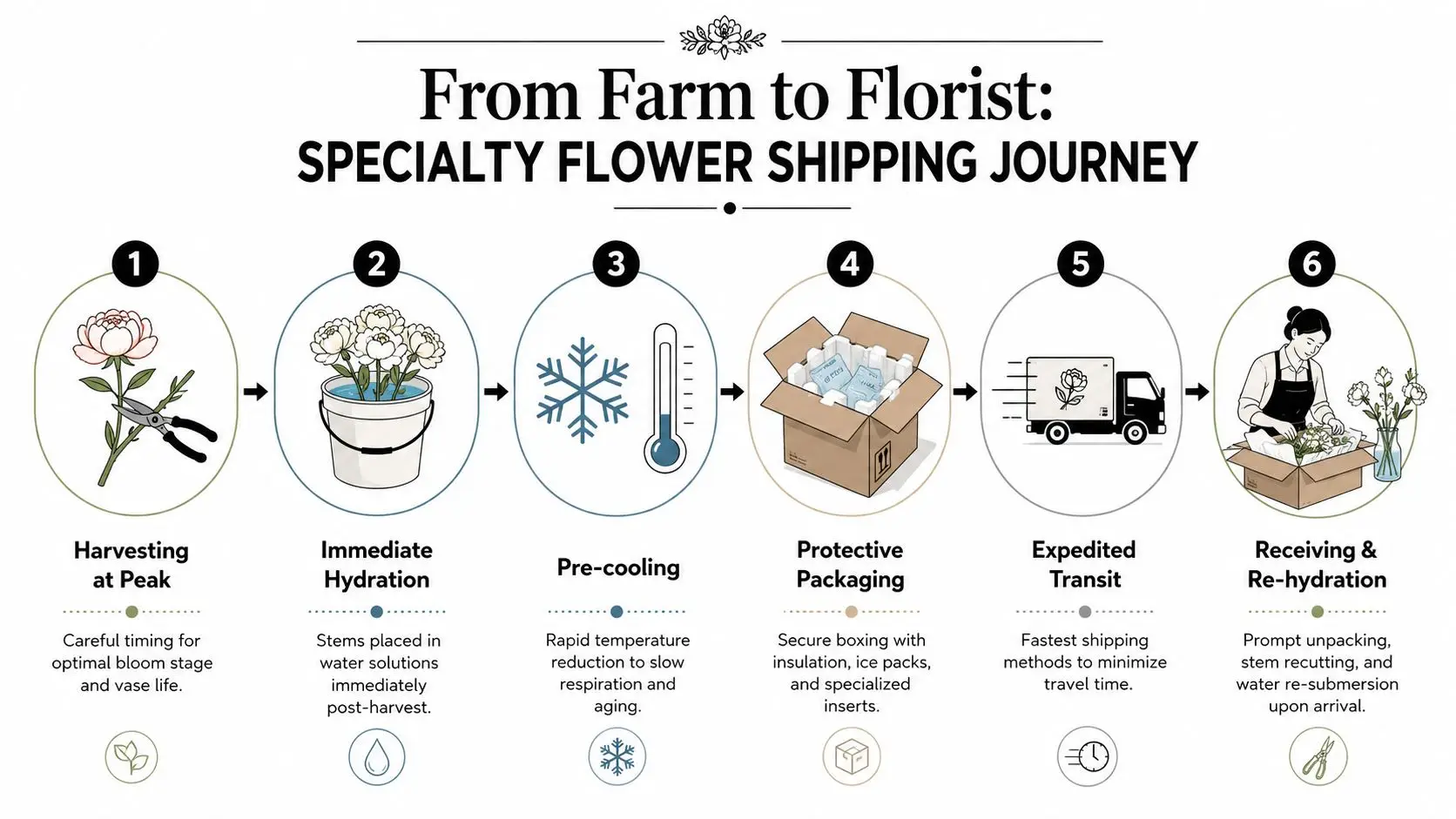
Good shipping starts with harvest timing and temperature control. Flowers cut in the cool part of the day usually hold hydration better in transit than stems harvested under heat stress. After cutting, the job is speed and protection. Grade quickly, bunch carefully, and get stems out of the sun and into a stable holding environment.
Packing should match the crop, not just the box size. Heavy-headed focal flowers need support so necks do not snap in transit. Branched material needs room so side blooms are not crushed flat. Delicate petals need sleeves or wraps that prevent abrasion without trapping excess moisture.
A seller who understands specialty flowers usually makes a few predictable decisions:
- Ships early in the week: This lowers the chance of boxes sitting in a carrier warehouse over the weekend.
- Chooses box depth for the stem type: Tall, airy stems need different support than dense bunches.
- Uses packing to control movement: Flowers should arrive secured, not rattling around loose.
- Plans around weather: Heat waves, freezes, and holiday bottlenecks change shipping risk.
- Sets realistic arrival expectations: Buyers should know whether flowers will arrive tight, thirsty, or not yet show-ready.
That last point matters. A good seller does not promise that every stem will look event-ready the minute the lid comes off. They explain the recovery window and the handling steps that follow. For event work, that information is as useful as the variety name. It also helps buyers choose designs that suit the material, whether they are building classic centerpieces or a more seasonal pumpkin vase with flowers for fall tablescapes.
What to do when the shipment arrives
Open the box right away.
Do the first inspection before you judge the flowers. Cool petals, slight limpness, and tighter buds are common after overnight shipping, especially with varieties that are packed for protection instead of display. What matters is whether the stems are sound, the bunches are clean, and the flowers recover once processed.
Use a simple arrival check:
- Check box condition: Crushed corners, heat buildup, or soaked cardboard can point to transit problems.
- Inspect the stems first: Firm stems usually tell you more than outer petals.
- Look for true damage: Bruising on guard petals is common. Split stems, blackened tissue, or rot are not.
- Process immediately: Recut stems and place them into clean water without delay.
- Allow recovery time: Many specialty blooms need a few hours, and some need overnight hydration, before you can assess saleable quality.
Florists and DIY buyers both get into trouble when they leave a delivery unopened while they finish other tasks. A shipping box is temporary protection, not storage. Warm rooms, parked cars, and sunny porches shorten vase life before design work even starts.
Judge shipped flowers after hydration, not by their first five minutes out of the box.
The practical trade-off is simple. Tight packing protects flowers from movement, but it can make them look flattened or sleepy on arrival. Looser packing can look prettier at first glance and cause more breakage in transit. Sellers who know their product choose the method that gets the stems to you in better working condition, even if the unboxing is less dramatic.
Conditioning and Care for Extended Vase Life
A stem can arrive in good condition and still disappoint in the vase if the first few hours are handled poorly. I see this most often with premium blooms that look strong in the bunch, then collapse early because they were dropped into warm water, crowded into a dirty bucket, or designed before they had time to drink.
Good conditioning is part of the purchase, not an optional extra. Specialty flowers cost more because they are harvested more selectively and handled more carefully. That advantage disappears fast if post-arrival care is sloppy.
The first hours set the ceiling
Start by processing flowers with intention. Use sanitized buckets, clean water, and a sharp blade that makes a clean cut instead of crushing the stem. Strip any foliage that would sit below the water line, then let the stems hydrate undisturbed before design work begins.
Cool temperature helps more than any fancy product. For most non-tropical flowers, colder storage slows water loss and respiration. Ethylene-sensitive varieties also hold better when they are kept away from ripening fruit, exhaust, and aging plant material, as noted earlier.
A few practices pay for themselves every time:
- Recut stems properly: A fresh cut improves water uptake, especially after shipping.
- Match the treatment to the flower: Woody stems, hollow stems, and soft stems do not all respond the same way.
- Give flowers recovery time: Some stems are ready in a few hours. Others need overnight hydration before you judge performance.
- Keep buckets spaced and clean: Crowded bunches bruise easily and dirty water shortens vase life.
- Pull weak stems early: One stem with rot or bacterial slime can foul a bucket quickly.
Different flowers ask for different handling. Dahlias and zinnias often benefit from warm to tepid hydration water at processing, while tulips and many spring bulbs prefer cooler conditions and gentle handling. Poppies, euphorbia, and other stems with sap need crop-specific treatment if you want reliable vase life. This is one reason mixed buckets can be inefficient. The best conditioning system is not always the fastest one.
Florist standards and realistic home care
A florist with a cooler, clean workspace, and time to stage product has an advantage. A home user can still get strong results by controlling the basics well.
For florists:
- Sort by crop and maturity: Do not lump hardy fillers, heavy focal blooms, and ethylene-sensitive flowers into one holding plan.
- Store with discipline: Repeated temperature swings shorten life, especially for delicate specialty stems.
- Use the right bucket depth: Some flowers want deep hydration. Others perform better with less water and good airflow around the heads.
For DIY users:
- Work in the coolest room you have: A shaded spare room beats a bright kitchen counter.
- Process as soon as the box is opened: Delays show up later as bent necks, weak petals, and short vase life.
- Refresh water and trim again if needed: If flowers are staying with you for a day or two before arranging, a second cut can make a visible difference.
One practical rule helps both groups. Do not confuse hydration with display. A flower that looks awkward in a bucket on day one often designs beautifully on day two. Patience is often the difference between a specialty stem that feels overpriced and one that earns its place.
Designing and Pricing with Specialty Blooms
Specialty stems change the design conversation because they don't need to be used in bulk to have impact. A single dramatic dahlia, a line of flowering branch, or a textured celosia can carry more visual weight than several standard filler stems.
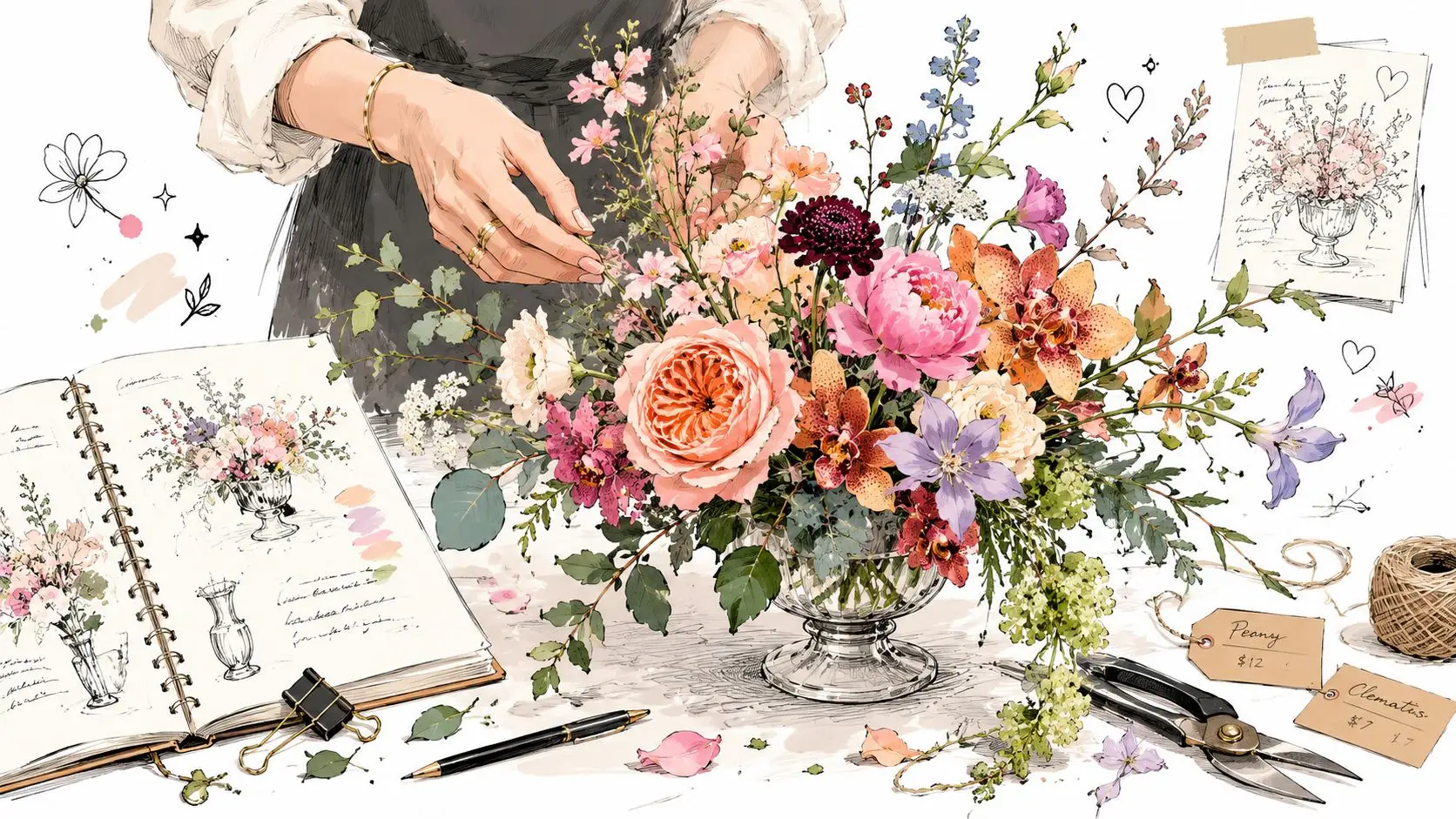
Using fewer stems more intentionally
A loose garden arrangement might rely on branching forms, shifting bloom sizes, and irregular movement. Dahlias, cosmos, and airy supporting material work well here because the arrangement feels collected rather than manufactured.
A cleaner, more modern arrangement often works better with fewer varieties and stronger silhouette. In that style, the point isn't abundance. It's control.
When pricing, the most useful client conversation is usually not about rarity alone. It's about labor, handling, and timing. Specialty flowers often require closer harvest timing, more careful conditioning, more selective sourcing, and stricter substitution decisions. That creates a different cost structure than ordering durable commodity blooms.
Clients also respond well when you describe value in visual terms:
- Distinct shape
- Seasonal authenticity
- Higher design impact per stem
- A more custom final look
A short visual example helps if you're developing a concept board or explaining mechanics to a client team.
Explaining cost without apologizing for it
Don't undersell specialty work by framing it as an indulgence. Frame it as a deliberate design choice.
Tell clients what they're paying for. They're paying for flowers that are often more seasonal, less interchangeable, and more sensitive in transit and handling. They're also paying for the result. If a ceremony arrangement needs to feel memorable in photographs and in person, stem choice matters.
The strongest budgets usually reserve specialty flowers for the places the eye lands first, then support them with dependable secondary material. That approach gives you character without wasting money.
Frequently Asked Questions
Can I mix specialty flowers with standard flowers
Yes. In fact, that is how many strong event recipes are built.
Use specialty stems where they will be noticed first, then support them with reliable flowers that hold shape, carry color, and do not crowd the design. A dinner arrangement might use a few standout blooms for gesture and identity, with standard roses, lisianthus, or carnations doing the quieter structural work.
The trade-off is balance. Too many statement flowers in one piece can make it feel restless. Too few, and you pay for premium stems without getting much visual return.
How should I transport a finished arrangement
Transport is usually where good work gets damaged.
Keep the arrangement cool, upright, and locked in place. Set each vessel in a box or crate that matches its footprint, then wedge around it so it cannot slide on turns or at stoplights. If the design has fragile faces or long branching stems, give those flowers air space instead of wrapping them tight and hoping for the best.
Do not run errands with flowers in the car. Heat builds fast, and specialty blooms show it quickly.
What should a first-time DIY wedding buyer order
Start with a small recipe you can handle well. One focal flower, one textural ingredient, and one supporting green or secondary bloom is enough for most first projects.
I usually tell new buyers to order for time as much as for stem count. Specialty flowers need to be unpacked, recut, hydrated, and watched. Some open fast. Some arrive tight and need a day to settle. If your event is Saturday, you need a plan for when the boxes arrive, where the buckets go, and who is available to process everything.
That logistics piece gets missed more often than flower choice.
When is the best time to process fresh stems
Earlier in the day is usually best, as noted earlier in the article. Cooler temperatures and fully hydrated stems give you a better starting point.
For shipped flowers, the practical version is simple. Open the box as soon as it arrives, check for heat or dehydration, recut stems cleanly, and get them into the right solution before the warmest part of the day. If your workspace heats up by afternoon, do your bucket prep and first hydration in the morning whenever possible.
That one decision often affects how calm the flowers look by design time.
If you're sourcing flowers for a wedding, event, or floral program and want a direct online option, Barbara's Flower Boutique LLC sells cut flowers online for florists, wedding organizers, event planners, and DIY couples. You can review available stems, plan around shipping needs, and choose flowers with the handling realities of specialty work in mind.
Discover more from Barbara's Flower Boutique
Subscribe to get the latest posts sent to your email.