
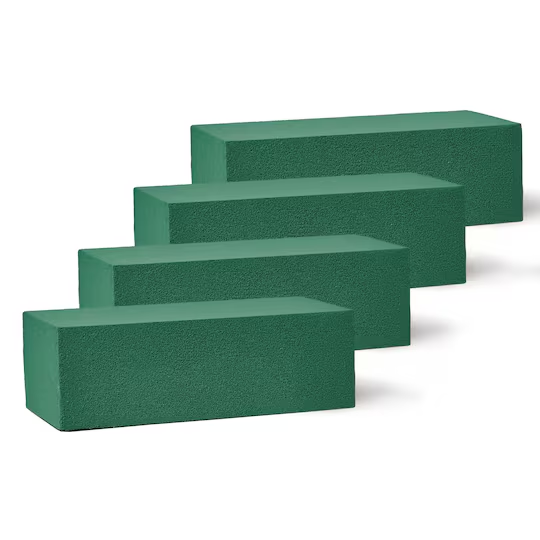
You’re probably looking at a green brick right now, or you’ve seen one in a florist’s cooler, a wedding prep room, or a tutorial video. It seems simple. Soak it, stick flowers in it, and everything stays in place. That’s why so many florists and DIY couples reach for it first.
But wet floral foam, often called Oasis, isn’t just a handy supply. It’s one of the most important and most debated tools in floral design. It solves real problems for events, installations, and time-sensitive work. It also comes with responsibilities that many casual guides overlook, especially if you’re working at home, in a garage, or in a venue without shop ventilation and cleanup systems.
If you’re a florist, planner, or couple building your own wedding flowers, you need both sides of the story. You need to know what this material does well, where it can let you down, and how to handle it without creating avoidable risk.
Table of Contents
- The Green Brick in Every Florist’s Toolkit
- What Is Wet Floral Foam and How Does It Work
- Why Florists Adopted It So Quickly
- What happens inside the foam
- Preparing and Using Floral Foam for Best Results
- The Pros and Cons for Weddings and Events
- Understanding the Safety and Environmental Risks
- Eco-Friendly Floral Foam Alternatives and When to Use Them
The Green Brick in Every Florist’s Toolkit
A couple planning a DIY wedding often has the same first reaction to wet floral foam Oasis. It feels like a shortcut to professional-looking flowers. You can see why. A centerpiece suddenly has structure. A ceremony piece looks fuller. A loose bundle of stems begins to resemble a design.
Professional florists know that feeling too. For decades, this green foam has been part of daily work because it makes difficult designs possible under pressure. If you need flowers to stay upright through setup, transport, and a long event window, foam can make that easier.
That history matters. Wet floral foam, especially the Oasis brand developed by Smithers-Oasis, has been the global industry standard for over 60 years since its invention in the 1950s, according to TCG Floral’s history of Oasis floral foam. It became central to modern floristry because it provided designers with a reliable water-holding base that also secured stems in place.
Wet foam didn’t become common because florists love waste. It became common because it solved hydration and structure at the same time.
That’s why you still see it in forms for small personal flowers, table work, sympathy designs, and large event installations. It’s not a niche product. It shaped the way modern florists build arrangements.
What confuses people now is that both things are true at once. It’s a foundational tool and a material many designers are rethinking. If you’re new to flowers, that can feel contradictory. It isn’t. It just means you’re dealing with a product that works well in practice while raising real concerns about safety, disposal, and environmental impact.
What Is Wet Floral Foam and How Does It Work
Wet floral foam is a specialized water-holding floral mechanic. In plain language, think of it as a structured sponge made for fresh flowers. It doesn’t just give stems something to lean on. It also stores water around them so cut flowers can keep drinking after you arrange them.

Why florists adopted it so quickly
Oasis became standard because it changed what florists could build. The material has been the global standard for over 60 years, since its invention in the 1950s, and can hold up to 50 times its dry weight in water, creating a reservoir that draws water into stems by capillary action, according to the Sustainable Floristry Council’s floral foam facts.
That matters in real design work. If you’re making a low centerpiece, the foam lets you place stems at angles rather than standing them upright in a vase. If you’re assembling a compact design from cheerful materials like Twenty-five French Bonita Mix Marigold Stems, which include gold, orange, and red blooms with delicately ruffled petals and lush green foliage for $50.00, foam provides a stable base for those shorter, branching stems.
What happens inside the foam
The easiest way to picture it is as a network of tiny open spaces that fill with water. When a stem is inserted correctly, the cut end comes into contact with moisture and can continue drawing water. That’s why arrangements built in wet foam can stay hydrated without the stems sitting directly in a pool of water.
Here’s the part many beginners miss. Foam isn’t ideal for every flower. The same Sustainable Floristry Council resource notes research showing a negative cause-and-effect relationship for cut roses, and industry experts conclude it shouldn’t be used during post-harvest handling of that species.
Practical rule: Wet floral foam Oasis is a mechanic, not a universal answer. Good florists still match the mechanic to the flower type.
So when people call floral foam “magic,” they’re partly right. It can support shape and hydration in one step. But it works best when you understand its limits, not when you assume every stem will respond the same way.
Preparing and Using Floral Foam for Best Results
The biggest mistakes with floral foam happen before the first flower goes in. If the block isn’t soaked correctly, the center can stay dry. If the density doesn’t match the flowers, the arrangement can slump. If you keep pulling stems out and reinserting them, the foam loses grip fast.

Start with proper soaking
Professional protocols call for submerging dry blocks horizontally and letting them saturate naturally for 30 to 90 seconds, depending on density. Full saturation matters because dry pockets create inconsistent hydration. The same guidance also recommends checking a cross-section so the inside matches the outside in color and dampness, as described in Alibaba’s guide to choosing floral oasis foam.
Use this sequence:
- Fill a clean container with enough water so the block can absorb moisture evenly.
- Set the block on the water gently: Let it sink on its own.
- Wait for full saturation: Don’t rush it.
- Handle it from underneath: Wet foam can crack if you grab it carelessly.
If you push the foam underwater, you can create “bridging,” where the outside gets wet but the interior doesn’t saturate evenly.
Match the foam to the job
Not all foam is the same firmness. For standard daily work, lower-density blocks may be fine. For heavier stems or designs that need to hold up through a long event day, the benchmark changes. A density of at least 42 kg/m³ is recommended for heavy-stem arrangements or multi-day events, according to the same Alibaba floral foam guide.
That spec is especially useful for weddings. Ceremony pieces often include heavier focal flowers, branching greens, or dramatic lines that put pressure on the base. If the foam is too soft, stems tilt and the whole shape can drift.
For design planning ideas, a visual concept like a pumpkin vase with a flower arrangement also shows why internal support matters when the container shape is awkward or decorative rather than purely functional.
Build with intention
Once the foam is wet and fitted to the container, slow down. Plan your stem placement before you start poking holes.
- Cut cleanly: Shape the block to fit the container without crushing the edges.
- Insert once when possible: Every removed stem leaves a widened channel behind.
- Work from support to detail: Add line flowers or greenery first, then medium flowers, then delicate accents.
- Check water contact: A stem that barely grazes the surface of a hole may not drink well.
A good foam arrangement looks relaxed, but the process behind it is deliberate. The more intentional your placement, the fewer hydration and stability problems you’ll have later.
The Pros and Cons for Weddings and Events
Weddings and events are where floral foam makes its strongest case. They’re also where its drawbacks become hard to ignore. If you’re deciding whether to use it, don’t ask whether it’s good or bad in the abstract. Ask what problem you need it to solve.

Where foam helps
For arches, urns, aisle meadows, and large centerpieces, foam offers structural control. You can place stems at angles, build asymmetry, and keep flowers hydrated without every container needing visible water. That’s a major advantage when the design has to be installed quickly and still look fresh hours later.
It also simplifies work for less experienced hands. A DIY couple can usually understand “insert stem into anchored base” faster than they can learn the mechanics of layered chicken wire in one afternoon. That’s one reason wedding tutorials often lean on foam-heavy methods. Couples exploring options like DIY wedding flowers often encounter it early because it lowers the technical barrier.
Where the trade-offs show up
The same convenience creates costs. Wet floral foam is generally single-use, so large events can use a lot of it in a single weekend. It’s also a plastic product, which changes how many florists and couples feel about using it for short-lived designs.
There’s also a design trade-off. Foam encourages fast building, but it can tempt people to over-insert and over-handle stems. Delicate stems can bruise, and repeated adjustments weaken the base. What saves time at the beginning can create problems during transport or cleanup if the work wasn’t planned well.
A balanced way to think about it looks like this: